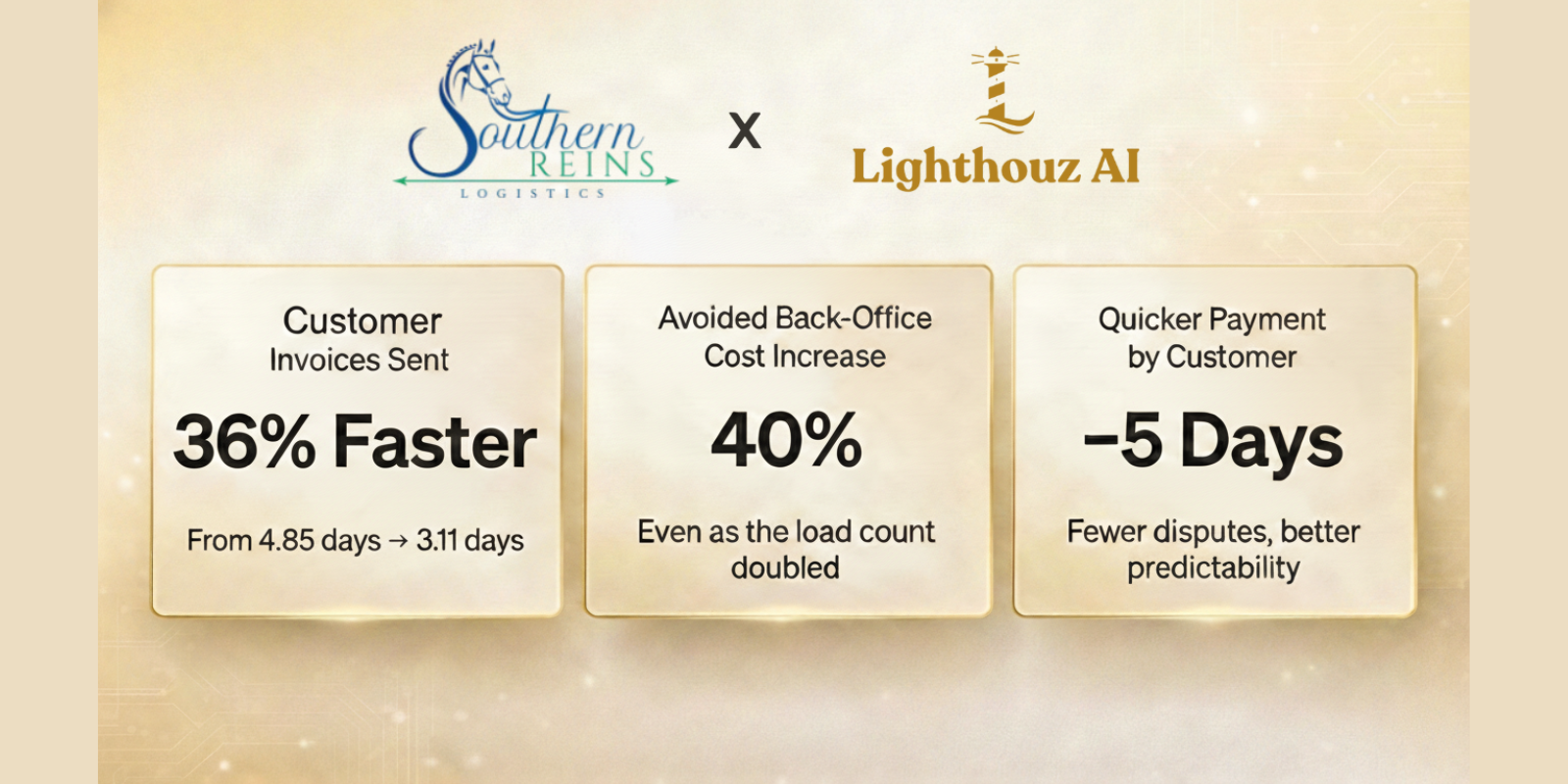

Long-tail AR is working capital leakage. When brokers only chase the largest overdue accounts, smaller invoices keep aging quietly. Accessorials, reweighs, detention, and short-pays creep into that pile until it becomes real cash. DSO rises without any single account looking broken.
Open any freight broker's aging report and watch what the collector does first. They sort by dollar value, descending. They work the names at the top: the shipper that owes $84,000, the account that has gone quiet for 50 days, the one finance asked about on the Monday cash call. Ten calls by lunch, and they have moved the most visible money they could move in an hour.
That instinct is rational. It is also incomplete. In a brokerage running thousands of loads a month, the bottom of the aging report is not a handful of stragglers. It is hundreds of smaller invoices piling up. Accessorial rebills, detention charges, $600 reweighs, small direct-shipper balances, and short-pays creep into that pile because none of them feels large enough to fight over individually.
Collectively, those invoices are a standing pile of cash the brokerage has often already fronted to carriers. The carrier payment left in 30 days. The shipper payment is pending on Net 45. No formal write-off is required for the damage to show up. It shows up as DSO creeping upward and working capital you cannot redeploy into the next hundred loads.
Long-tail AR in freight brokerage is the large set of smaller overdue invoices that sit below the biggest accounts on an aging report. The large accounts still represent the largest individual balances, but the small invoices pile up into meaningful cash. In freight, accessorials, detention charges, reweighs, reclasses, and short-pays often creep into that pile. Individually, they look too small to chase. Collectively, they raise DSO and trap working capital.
The Long Tail Is Where Recoverable Cash Hides
Working the top accounts first is not wrong. It is just incomplete. The 80/20 split is real: a small number of customers usually carry most of the dollar exposure. But the way collections vendors describe their own products gives away how much money sits in the rest. HighRadius, one of the larger AR automation players, frames its tool around prioritizing worklists for the top 20% of customers while automating collections for the roughly 80% of long-tail customers, reporting that doing so cuts past-due accounts by about 20% and lifts collector productivity by roughly 30%.
Read that twice. The long tail is not where there is no money. It is where there is enough money to produce a measurable swing, but not enough money per invoice to justify human follow-up by hand. A $50,000 invoice and a $600 invoice can take a similar number of emails, document pulls, and portal checks to collect. On the small one, that effort can cost more than the margin it protects, especially for companies handling large volumes of low-value invoices. So the effort does not get made. The tail sits.
Aging Turns "We'll Get to It" Into Compounding Cash Flow Drag
Every day a small invoice sits uncollected, it is not neutral. It is cash the brokerage fronted to a carrier that is not cycling back. Every 10 days cut from DSO frees roughly $1.37M in working capital for a $50M-revenue company. A meaningful share of stubborn DSO often lives in exactly these long-tail accounts that nobody is actively working.
The operational decay is real too. The longer an invoice sits, the harder it gets to resolve. The point of contact who could have approved the accessorial has moved on. The remittance email is buried under newer ones. The reweigh dispute was never documented while the load details were fresh. Across the US, roughly 44% of B2B invoices are now overdue, and about 5% of invoices that reach the long-overdue bucket are eventually written off. That is the tail risk, not the daily cost. The daily cost is the $39,000-plus annual drag from late payments that many companies absorb without naming it.
When a neglected invoice does need escalation, the options shrink fast. Send it to a collection agency and you may forfeit 40% or more to contingency fees. A $700 accessorial recovered at 40% contingency nets $420, if it is recovered at all. The cheapest dollar to collect is usually the one chased early, while the documentation is still fresh and the shipper has context.
Why This Breaks Worse in Freight Than in Generic B2B
A horizontal AR tool looks at an aging report and sees invoices. A freight-native collections system has to see why the small invoices exist. That difference is the whole problem.
In freight, the long tail starts as smaller invoices piling up below the large accounts. Then the freight-specific items creep in: accessorials, detention, lumper fees, reweighs, and reclasses. Each one was billed after the fact. Each one often needs a signed BOL, reweigh certificate, detention log, timestamp, or portal-specific proof to substantiate. Each one is the first thing a shipper's AP team questions.
Timing makes the problem sharper. Brokers typically owe their carriers within 30 days of delivery, while shippers pay on Net 45. Every dollar stuck in the un-chased tail is a dollar the brokerage has already extended. The mismatch that makes freight cash flow hard is the same mismatch that makes ignoring small receivables expensive.
Why Generic AR Automation Only Solves Half the Problem
Generic AR automation can send more follow-up emails. That helps when an invoice is simply waiting on a reminder.
But freight collections usually need more than another reminder. A small invoice in the tail is rarely stuck because the shipper forgot to pay. It is often stuck because an accessorial was flagged as undocumented, the portal rejected the invoice for a missing BOL, or a detention charge came in without the timestamps the customer needs to approve it.
Sending another email does not close that. Attaching the right document, to the right invoice, with the right freight context does. Generic AR tools can automate the outreach. Lighthouz AI is built to automate the freight-specific resolution work behind the outreach.
| Capability | Generic AR Tool | Lighthouz AI |
|---|---|---|
| Follows up on every invoice, not just the top accounts | Limited by setup | ✓ |
| Understands accessorial, detention, reweigh, and reclass disputes | ✗ | ✓ |
| Auto-attaches supporting documents like BOLs, detention logs, and certificates | ✗ | ✓ |
| Surfaces aging long-tail invoices before they drag DSO past easy recovery | Partial | ✓ |
| Scales across thousands of small invoices without added collections headcount | Partial | ✓ |
What CFOs Should Automate
The fix is not telling collectors to chase the small stuff too. There are not enough hours in the day, and the unit economics still do not work by hand. The fix is making the floor of the aging report run on its own.
Every account should be touched on schedule, not just the ones a human had time for. Follow-ups on disputed smaller invoices should already carry the supporting document, so accessorials, reweighs, detention charges, and other small-balance issues resolve instead of stalling. Collectors should spend their judgment on the genuinely complex, high-dollar situations where human attention changes the outcome.
That last split matters. Truckstop's 2026 broker survey found 41% of brokers adding AI and machine-learning tools to their back office while 48% are still holding off. The brokers in the first group are not just moving faster on the accounts at the top of the aging report. They are the ones who stopped letting the bottom half quietly rot.
- Your collectors sort the aging report by balance due every morning.
- Smaller invoices regularly age past 45 days, with accessorials, detention charges, reweighs, and short-pays buried inside the pile.
- Your team does not know the total value of overdue invoices under $1,500.
- Portal rejections are discovered after the payment window has already slipped.
- Customers short-pay small freight charges because the proof was not attached early.
- Finance wants faster collections, but adding collectors does not make economic sense.
| CFO Question | Direct Answer |
|---|---|
| What is the financial risk? | Higher DSO and working capital trapped in small overdue invoices. |
| Why does it happen? | Manual collectors rationally prioritize the largest balances first. |
| Why is freight different? | Small invoices pile up first; then accessorial proof, BOLs, certificates, logs, and portal-specific documentation decide whether those invoices get paid. |
| What solves it? | Automated follow-up plus freight-native document matching and dispute resolution. |
Frequently Asked Questions
What is long-tail accounts receivable in freight brokerage?
Long-tail accounts receivable is the large number of smaller, lower-priority invoices that sit below the big accounts on a freight broker's aging report. The big accounts still hold the biggest individual balances, but the smaller invoices pile up into a meaningful amount. In freight, accessorials, detention, reweighs, reclasses, small direct-shipper balances, and shipper short-pays often creep into that pile. Any one invoice is minor on its own. Together, they represent real cash the brokerage has already fronted to carriers and has not collected back from shippers.
Why do freight brokers under-collect on small accounts?
Manual collections cost roughly the same per invoice regardless of size. Chasing a $500 invoice by hand can cost more than the margin it protects. Collectors rationally work the big accounts first, and the long tail goes untouched until it ages into a harder-to-resolve bucket.
How do small overdue invoices affect DSO?
Small overdue invoices increase DSO because they keep cash in the aging bucket even when no large customer account looks alarming. In freight brokerage, this is especially painful because carriers are often paid before shippers pay. Every delayed shipper payment extends the cash conversion gap.
How much does it cost to ignore small overdue invoices?
The primary cost is not always a formal write-off. The daily cost is working capital tied up in the aging bucket: cash the brokerage already paid to carriers that is not cycling back from shippers on time. As invoices age, resolution also gets harder because contacts change, dispute details go undocumented, and the window for clean resolution closes.
Can generic AR automation tools fix this for freight brokers?
Generic AR tools can automate outreach, which helps small accounts get touched instead of ignored. But they often cannot resolve the freight-specific reason an invoice is stuck. In freight, many smaller invoices in the long tail need a missing BOL, accessorial proof, reweigh certificate, detention log, or portal-specific correction. Another reminder email does not resolve that. The right document and context do.
What is the fastest way to recover long-tail cash without adding headcount?
Automate routine follow-up on every account, attach supporting documentation to disputed-charge reminders automatically, monitor portal rejections early, and reserve human collectors for high-dollar or genuinely complex cases where judgment actually changes the outcome.
Find the Cash Trapped in Your Long-Tail AR
Most brokers have never put a number on the cash sitting in the bottom half of their aging report because no one has had time to work it.
Lighthouz AI helps freight brokers quantify how much overdue cash is sitting below the top accounts and recover more of it without adding collections headcount.
Book a demo with Lighthouz AI