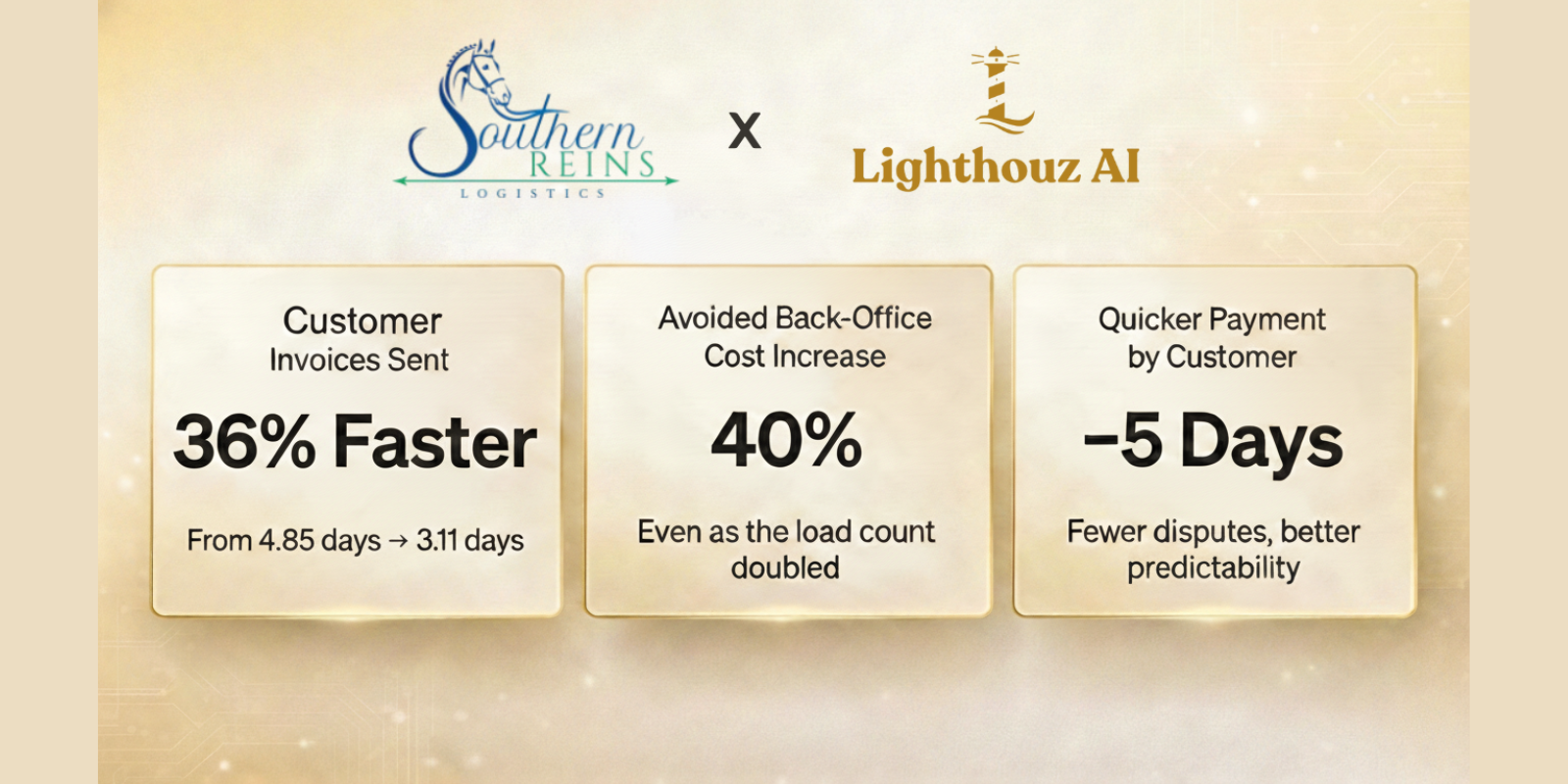
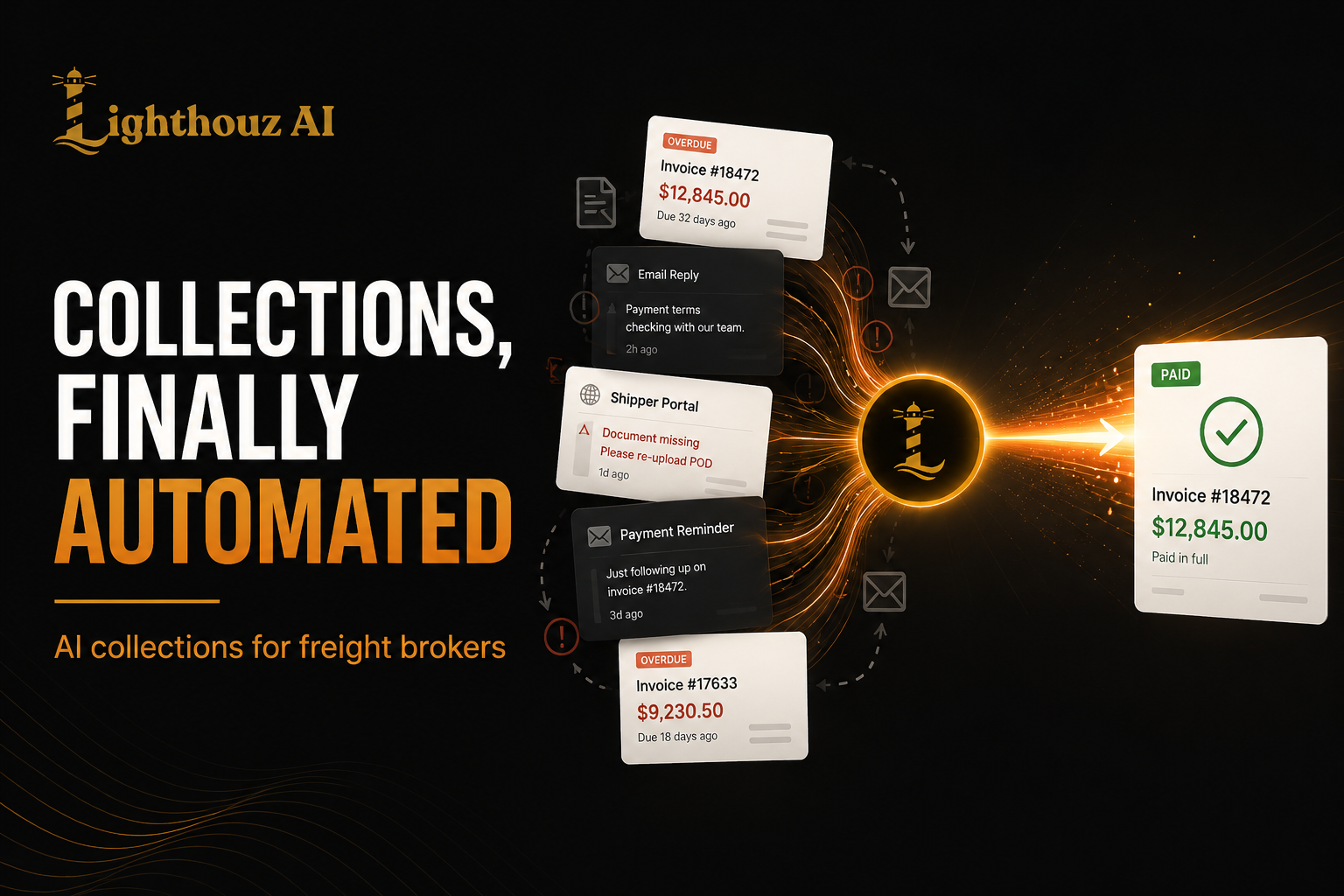
Freight brokers automate quoting, dispatch, and tracking — then lose ~5–10 days of cash flow to a process still run out of someone's inbox.
Teams still manage collections through inboxes, spreadsheets, customer portals, PDFs, shared drives, and scattered notes. Collectors spend hours checking invoice status, following up manually, logging into portals, answering repeat customer questions, and trying to figure out what is actually paid, disputed, rejected, or still outstanding.
A collector starts Monday with four tabs open — the TMS, a spreadsheet of last week's follow-ups, an inbox full of customer replies, and a portal login screen — just to piece together which invoices actually got paid.

Transportation companies that automate AR reduce DSO by an average of 13 days, and 73% report faster cash flow. Yet most freight brokers still manage collections through inboxes, spreadsheets, customer portals, and disconnected systems.
Existing Collections Tools Were Not Built for Freight
Most collections tools were built for generic accounts receivable teams. They were not built for freight.
Generic AR tools do not monitor customer portals. They do not track rejected invoices in real time. They do not flag missing PODs, disputed accessorials, missing backup documents, short-paid invoices, or portal rejections.
Collectors still need to switch between TMS platforms, email, accounting systems, spreadsheets, and customer portals just to understand what happened to a single invoice.
Instead of reducing admin work, most tools create more of it.
Freight collections are more complex because invoices depend on PODs, lumper receipts, accessorials, revised rates, missing documents, and customer-specific portal requirements. Generic AR tools were never built for that.
| Capability | Generic AR Tool | Lighthouz AI |
|---|---|---|
| Tracks PODs & lumper receipts | ✕ | ✓ |
| Monitors customer portals automatically | ✕ | ✓ |
| Flags rejected / short-paid accessorials | ✕ | ✓ |
| Real-time dispute & rejection alerts | Manual only | ✓ |
| Per-customer reminder customization | Limited | ✓ |
| Built for freight-specific exceptions | ✕ | ✓ |
Lighthouz AI Gives Brokers One Real-Time Collections Workflow
Lighthouz AI gives freight brokers one collections workflow tied directly to freight invoices, customer communication, payment status, disputes, and exception handling.
Instead of manually checking dozens of systems, teams get one real-time collections workflow.
Lighthouz AI does not force collectors to hunt for answers. It brings invoice status, customer communication, disputes, reminders, notes, and collections activity into one place.
1. Lighthouz AI Monitors Customer Portals and Surfaces Rejections in Real Time
Customer portals are one of the biggest reasons collections slows down. Collectors waste time logging into multiple portals to check invoice status, payment updates, disputes, missing documents, and rejected invoices — and by the time someone notices a rejection or dispute, the invoice is already aging.
Lighthouz AI continuously monitors customer portals automatically and surfaces disputes, rejections, and exceptions the moment they happen.
- It checks for invoice status changes and tracks payment updates
- It flags disputes and rejections as soon as they occur
- It catches missing PODs and missing backup documents
- It identifies rejected accessorials and short-paid invoices
- Teams can see when a customer disputes a charge or when backup documentation is missing
- Teams can prioritize issues before they become aged receivables
Teams no longer need to manually log into every customer portal every day. If an invoice is rejected, disputed, or delayed, the system flags it immediately so the collections team can act faster.
2. Reminder Sequences Can Be Customized Per Customer
Not every customer should receive the same reminder workflow. Some customers need soft reminders. Others need more aggressive follow-up. Some accounts require escalation after a certain number of days. Others need a completely different process.
Lighthouz AI allows teams to customize reminder sequences by customer, account type, payment behavior, or risk level.
- High-risk customers can receive more aggressive follow-ups
- Strategic accounts can follow softer reminder workflows
- Teams can customize reminder timing and escalation paths
- Outreach can be tailored to different customer requirements
This gives collections teams more control without creating more manual work.
3. AI Handles Repetitive Customer Questions Automatically
Collections teams waste a huge amount of time answering the same questions over and over. Customers ask for invoices, PODs, statements, backup documents, outstanding balances, and revised invoices. They ask questions like "I never got the invoice," "Can you send my statement?," or "Can you resend the POD?"
Lighthouz AI's AI agent automatically responds to common collections requests. The AI agent can send invoices, statements, PODs, and supporting documents without forcing collectors to handle every request manually.
This removes repetitive work from the collections team and speeds up customer response times.
4. Finance Teams Get Real-Time AR Visibility, and Collections Activity Lives in One Place
Most finance teams still rely on manual reports and spreadsheet updates to understand collections performance. That creates delays. By the time leadership sees the data, the information is already outdated.
Lighthouz AI gives CFOs, CEOs, and Controllers a real-time AR dashboard with visibility into outstanding invoices, overdue invoices, aging trends, cash flow risk, disputes and exceptions, collections activity, and collector performance.
CFOs and Controllers no longer need to wait for manual reports or spreadsheet updates. For finance leaders, collections is not just an AR problem. It is a cash flow forecasting problem. Teams can see what is paid, what is outstanding, what is at risk, and where collectors should focus next.
That same visibility extends to the team on the ground. Collections breaks down when information is spread across multiple systems — one collector has notes in email, another has updates in a spreadsheet, someone else stores customer responses in a shared drive. Lighthouz AI keeps it all in one place: collections notes, customer conversations, invoice history, payment status, reminder activity, disputes and exceptions, and portal updates. Teams no longer lose information across inboxes, spreadsheets, and disconnected systems.

5. Human Collectors Focus on the Right Accounts
The best collections teams should spend time resolving disputes, chasing high-risk accounts, and managing aging receivables. They should not spend their day resending invoices, checking portals, or answering the same customer questions repeatedly.
Lighthouz AI creates a prioritized work queue for human collectors.
- High-risk accounts move to the top of the queue
- Disputed invoices can be prioritized immediately
- Aging receivables become easier to manage
- Routine follow-ups and repetitive admin work are automated
Freight Brokers Need a Collections Workflow Built for Freight
Manual collections are too slow, fragmented, and reactive for modern freight brokerages. Freight brokers do not need another generic AR tool.
They need a collections workflow built around customer portals, freight invoices, disputes, missing documents, accessorials, payment status, and real-time visibility. That is exactly what Lighthouz AI delivers.
Ready to See It in Action?
If your team is still managing collections through spreadsheets, inboxes, and portal logins, you are already behind.